How a Modbus AC Controller Can Make Climate Control Part of Smart Automation
It is 10:30 at night.
The lights are dimmed.
The curtains are closed.
The room is ready for sleep.
But the air conditioner is still running at the same daytime setting.
This is where smart automation starts to become more meaningful.Not because one more device becomes “connected,” but because different systems begin working together.That includes climate control.
AC Control Should Not Work in Isolation
Lighting, fans, curtains and air conditioning all influence how comfortable a room feels.
Yet in many spaces, each function is controlled separately.
A Modbus AC controller can help bring air-conditioning control into a wider building automation environment.
Instead of treating the AC as a standalone appliance, it can become part of coordinated routines, scenes and centralized controls.
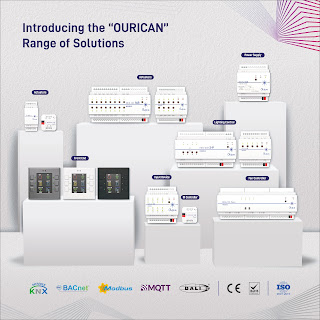
Ourican’s automation portfolio includes air-conditioning controllers alongside actuators, dimmers, fan controllers, keypads and control processors across KNX and MODBUS-based systems.
Think in Scenes, Not Individual Devices
Consider a simple “Away” scene.
Instead of manually checking every room before leaving, one automation command could coordinate several functions.
Lights switch off.
Curtains move to the preferred position.
Fans stop.
Climate settings are adjusted.
This is where integrated control becomes more useful than individual smart devices.
A Modbus AC controller becomes part of the larger automation logic rather than another separate control point.
Why MODBUS Works Well in Connected Spaces
MODBUS is widely used as a communication protocol for automation because it allows different devices to exchange information within a structured control system.
For homes, offices and hospitality environments, this can help connect climate control with other building functions.
The important question is not:
“Can the AC be automated?”
It is:
“Can the AC work intelligently with everything else in the space?”
That shift creates a more connected experience.
Comfort Can Follow the Routine
Imagine an office.
At the beginning of the day, the automation system prepares selected areas before employees arrive.
During working hours, climate settings can follow operational requirements.
At the end of the day, systems can move into an energy-conscious mode.
A hotel room may have completely different routines.
A residence may prioritize personalized scenes.
Different spaces.
Different requirements.
But the principle remains the same: climate control becomes more useful when it participates in the wider automation strategy.
Ourican and Integrated Building Control
At Ourican, automation solutions are developed around both KNX and MODBUS protocols, with products spanning lighting, fan control, AC control, system devices and centralized interfaces.
The objective is not simply to connect more devices.
It is to make those devices work together in a way that improves comfort and control.
Smarter Climate Control Is About Coordination
A connected air conditioner is useful.
An air conditioner that understands its role within a larger scene is more useful.
That is the real value of integrating climate control into building automation.
Because smart spaces are not created when every device gets its own app.
They are created when different systems begin behaving like parts of the same environment.
.png)
Comments
Post a Comment